Containers: Docker and Apptainer
CBIO7501 · Lesson 08
Today you will
- run tools inside containers, with your project mounted
- build an image of the LTEE environment from
pixi.lock - get the same variant calls on another operating system
- record which image made a result
Containers in life science
- CAMI, a community benchmark of metagenomics tools, asked every participant to submit the tool as a Docker container, with its parameters and databases, so the organizers could rerun it (Sczyrba et al. 2017)
- The second round accepted a container, a Bioconda recipe, or a repository with installation instructions (Meyer et al. 2022)
A container is a way to hand someone the whole working setup, not just the code.
What the lock file cannot pin
your analysis        ← Git (lesson 04)
Python, samtools …   ← pixi.lock (lesson 05)
C library, OS tools  ← ???      ← a container pins this too
kernel, hardware     ← nobody
Image and container
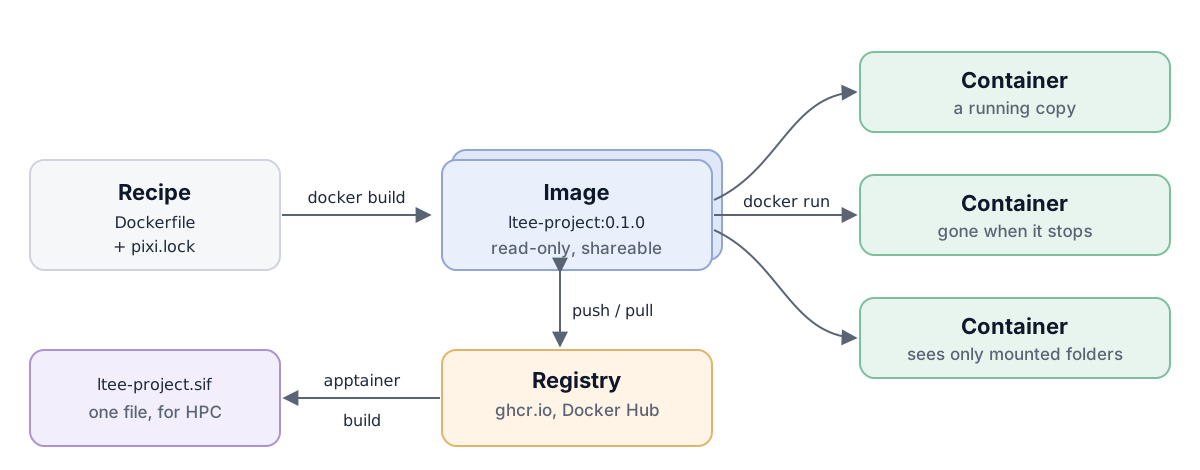
- Image: software plus a minimal operating system, read-only; container: a running copy of it
- Tag (
:0.1.0) can move; digest (@sha256:…) cannot
Another operating system, one command away
The container brings its own operating system files; it borrows only the kernel of the computer it runs on (on a Mac, a small Linux virtual machine).
A container sees only what you mount
-v "$PWD":/work puts your project folder at /work inside the container; -w /work starts there. Results written to /work land in your project.
Docker or Apptainer?
| Docker | Apptainer | |
|---|---|---|
| Where | laptops, GitHub Actions | HPC clusters (Linux only) |
| Needs root? | a root service | no |
| Your files | mount with -v "$PWD":/work |
home and current folder mounted automatically |
| Same image? | builds it | converts it: apptainer build x.sif docker://… |
| Images | stored by the Docker service | single .sif files you can copy |
| Isolation | separate file system by default | sees much of the host’s |
| Runs on | Linux, macOS, Windows | Linux (macOS and Windows only in a VM) |
Singularity became Apptainer under the Linux Foundation in 2021. Sylabs’ fork, SingularityCE, released 4.6.0 in October 2026 and says it is expected to be its final release. Apptainer still runs the singularity command and SIF images.
What should go in a container?
- The environment: tools and libraries. Yes: this is what containers are best at
- Your code with the environment: possible, but now every code change needs a new image
- The whole project, data included: hard to update, hard to inspect
Best overall: a Git repository with code, documentation, the environment files (pixi.toml, pixi.lock, Dockerfile) and instructions to download the data; the image is built from it, and archived with each release.
The Dockerfile, in three ideas
FROM ghcr.io/prefix-dev/pixi:0.83.0 AS build          # 1. Pixi's image
COPY pixi.toml pixi.lock ./
RUN pixi install --locked --environment pipeline      #    exactly the lock file

FROM ubuntu:24.04 AS production                        # 2. small final image
COPY --from=build /opt/project/.pixi/envs/pipeline /opt/project/.pixi/envs/pipeline
ENTRYPOINT ["/entrypoint.sh"]                          # 3. activate, then run
Container and laptop cannot drift: both come from pixi.lock.
Run the pipeline in it
10, 25 and 775 variants: the same as on your laptop.
Think, pair, share
3 minutes. A paper gives a Docker Hub image name lab/tool:latest as its “reproducible environment”. What could go wrong in two years? What would you ask the authors to add?
Quiz
docker run ltee-project:0.1.0 bash scripts/run_variant_calling.shsays “No such file”. Why? (a) image broken (b) project not mounted (c) wrong tag- Which pins an image exactly? (a)
:latest(b):0.1.0(c)@sha256:… - Where do you use Apptainer instead of Docker? (a) on a Mac (b) on an HPC cluster (c) in Word
Recap
- Images pin software and the OS layer; containers run them
- Build images from
pixi.lock; mount your project with-v - Record digests and archive the image with a release
- Docker on laptops and CI; Apptainer on clusters
- More: Docker docs, Dockerfile reference, Apptainer docs
Now: tutorial 08.
Sources
- Tools for Reproducible Research, NBIS. CC BY 4.0. https://nbisweden.github.io/workshop-reproducible-research/
- Week 1 slides 68 to 70 (why containers; Docker and Singularity for HPC) are the opener. Update to slide 70: Singularity became Apptainer under the Linux Foundation in 2021; SingularityCE is Sylabs’ separate fork. This course uses Apptainer.
- Nüst D et al. (2020). Ten simple rules for writing Dockerfiles for reproducible data science. PLoS Comput Biol 16:e1008316. https://doi.org/10.1371/journal.pcbi.1008316
- Pixi documentation, Containerizing: https://pixi.prefix.dev/latest/deployment/container/
- Sczyrba A et al. (2017). Critical Assessment of Metagenome Interpretation: a benchmark of metagenomics software. Nat Methods 14:1063–1071. https://doi.org/10.1038/nmeth.4458
- Meyer F et al. (2022). Critical Assessment of Metagenome Interpretation: the second round of challenges. Nat Methods 19:429–440. https://doi.org/10.1038/s41592-022-01431-4
- SingularityCE README, End of Life / End of Engineering notice (read 2026-10-25): https://github.com/sylabs/singularity
- Docker documentation: https://docs.docker.com/; Apptainer documentation: https://apptainer.org/docs/user/latest/
- Diagram ‘Image and container’: own work, CC BY 4.0, after the NBIS figure.
Text and slides CC BY 4.0 unless marked otherwise. Full list: Sources and credits.
CBIO7501: The Art of Reproducible Research - CC BY 4.0