Putting it all together
CBIO7501 · Lesson 12
Aziz Khan
Today you will
- reproduce a classmate’s project from a clean clone, with only its README
- report what worked, what did not, and the one fix that helps most
- release your
ltee-projectwith a DOI - take a checklist into your next project
Take control of each part
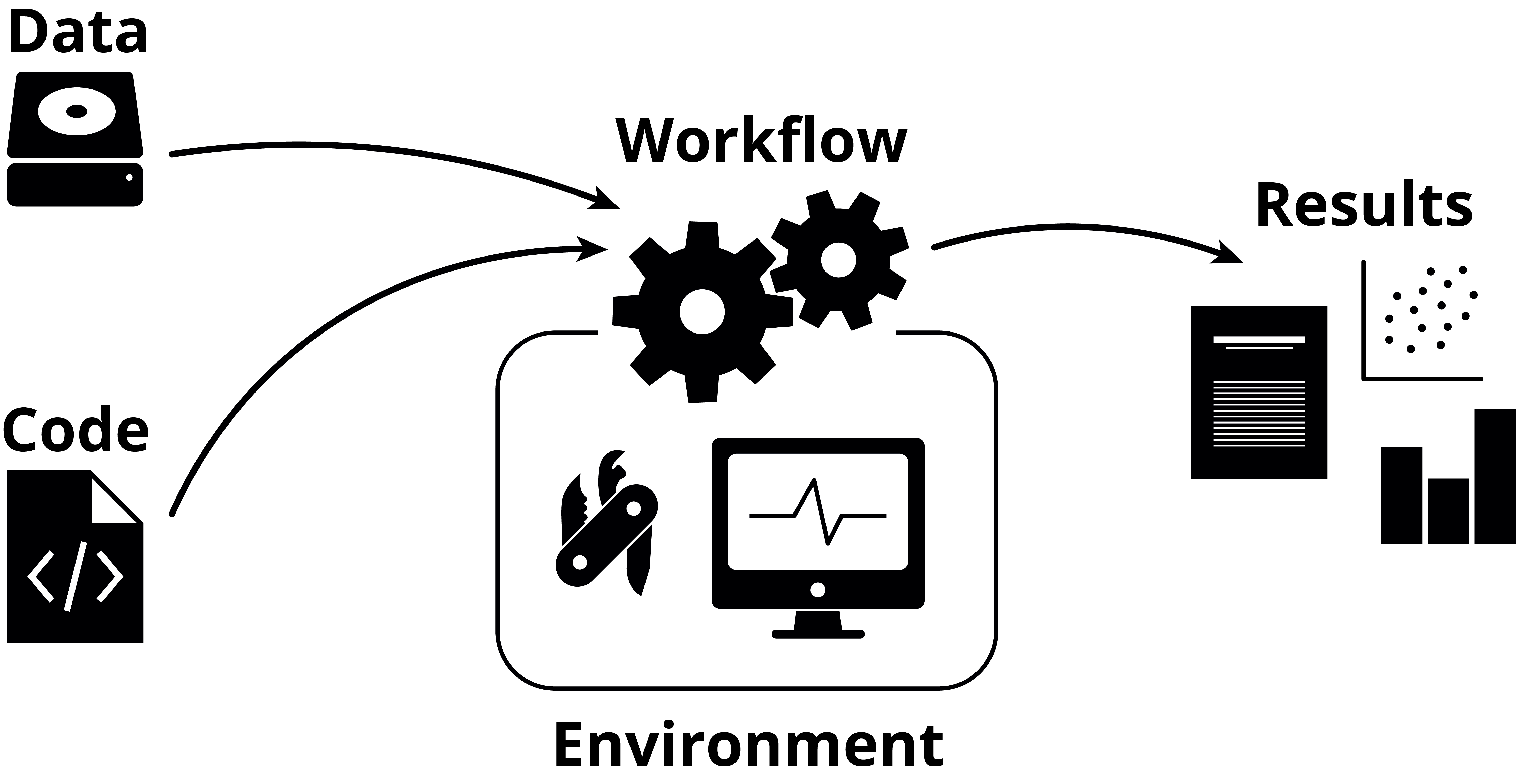
Figure: NBIS, Tools for Reproducible Research, CC BY 4.0
Data, code, environment, workflow, results: you now have a tool for each.
The five pillars, revisited
| Pillar | Your LTEE project |
|---|---|
| Literate programming | reports/ltee-report.qmd, notebooks/ |
| Version control and sharing | Git, GitHub, pull requests, releases |
| Environment control | pixi.toml + pixi.lock, containers/Dockerfile |
| Persistent data sharing | figshare + NCBI, checksums in metadata/ |
| Documentation | README, CITATION.cff, decisions log |
Glue: Snakemake/Nextflow and the Reproduce GitHub Action.
The real test
Can someone else get your results, from your repository alone, without asking you?
Today that someone is your neighbor.
Swap and reproduce: the rules
60 minutes.
- Clone your partner’s capstone into a new folder
- Use only the repository: no questions, no looking over shoulders
- Fill in the reproduce report as an issue on their repository
- 15 minutes: read both reports together; agree on one fix each
What usually goes wrong
- A file that only exists on the author’s laptop (
git statusshows??) pixi.tomlchanged,pixi.locknot committed- Data downloaded by hand, not by a script
- An absolute path, or a command missing from the README
- Results that differ, and nobody wrote down what to expect
Most of these turn the Reproduce check red before anyone else tries.
Release: a version with a DOI
git tag v1.0.0 ──► GitHub release ──► Zenodo archives it ──► DOI
(title, authors, license from CITATION.cff)- Practise on sandbox.zenodo.org first
- New release, new version DOI; the concept DOI always points to the latest
ltee-project: public, real Zenodo DOI, hand it in- Capstone: a GitHub release is enough; private (shared with the instructor) is fine; sandbox DOI optional
Habits to keep
Projects
- one folder per project, from raw data to results
- one Git repository per project
- data and results stay out of Git
- commit often
Data
- raw data read-only
- no hand-edited copies: script every change
- backups in more than one place
- deposit raw data early
Code
- nothing by hand that code can do
- scripts, reports and workflows connect raw data to results
- settings in a config file, not in the code
What is reasonable for your next project?
| Level | Practices |
|---|---|
| Minimal: reproducible code and environment, from day one | template, Git + GitHub, raw data read-only and scripted, pixi.toml/pixi.lock committed |
| Good: structured and documented | Quarto report or notebooks under Git, Pixi tasks or Snakemake, CI reproduce check, README + CITATION.cff |
| Great: the full environment, connected in a workflow | containers built from the lock file, Snakemake or Nextflow (nf-core on clusters), releases with DOIs |
Every tool has alternatives
| Job | This course | Alternatives |
|---|---|---|
| version control | Git | Jujutsu (Git-compatible), Mercurial, Subversion |
| environments | Pixi | Conda / Mamba, pip and uv (Python only), apt / brew (system) |
| workflows | Snakemake, Nextflow | Make, CWL and WDL, Galaxy (web interface) |
| literate programming | Quarto, Jupyter | R Markdown, Marimo (reactive Python notebooks) |
| containers | Docker, Apptainer | Podman, virtual machines (VirtualBox) |
The ideas transfer: a record of changes, a pinned environment, an automated pipeline, a document computed from data.
Quiz
- Your partner’s clone fails, yours works. Most likely cause? (a) their laptop (b) something on your laptop is not committed (c) GitHub
- What does a Zenodo release give you that a GitHub repository does not? (a) a website (b) a permanent archive with a DOI (c) CI
Recap
- Reproducibility is tested by someone else, from a clean clone
- CI catches most failures before your colleague does
- Release + Zenodo = a citable, permanent version
- Start your next project with the checklist, not at the end
Now: tutorial 12, the LTEE project hand-in and the capstone rubric.
Sources
- Tools for Reproducible Research, NBIS. CC BY 4.0. https://nbisweden.github.io/workshop-reproducible-research/
- Week 1 slides 97 (Zenodo homework) and 98 (checklist) are the basis; the checklist is updated for Pixi.
- Ziemann M, Poulain P, Bora A (2023). The five pillars of computational reproducibility. Brief Bioinform 24:bbad375. https://doi.org/10.1093/bib/bbad375
- Sandve GK et al. (2013). Ten simple rules for reproducible computational research. PLoS Comput Biol 9:e1003285. https://doi.org/10.1371/journal.pcbi.1003285
- Figure ‘Take control of each part’: NBIS, Tools for Reproducible Research, CC BY 4.0.
Text and slides CC BY 4.0 unless marked otherwise. Full list: Sources and credits.
CBIO7501: The Art of Reproducible Research - CC BY 4.0